Choosing to Leave Rather Than Flee
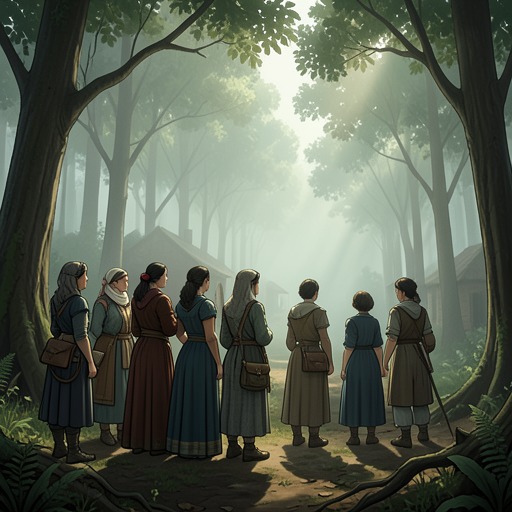
Women TalkingChoosing to Leave Rather Than Flee is the women’s insistence that their departure from Molotschna is a deliberate collective decision, not a panicked escape. The distinction does not erase the coercion surrounding them: after years of sexual assaults, the women face an ultimatum to forgive the accused men or leave the colony. Their language of choice claims authorship over a movement whose immediate causes lie in violence and the threat of expulsion.
The Conditions of Departure
The crisis that makes leaving necessary has persisted for years. Since 2005, women and girls in Molotschna have been attacked at night after being rendered unconscious with belladonna anesthetic spray used on farm animals. The assaults were first attributed to ghosts or Satan; the attackers were eventually identified as eight men from the colony, many close relatives of their victims. The women must decide how to respond while those men are imprisoned and awaiting trial.
Peters and the elders make forgiveness part of the colony’s terms of belonging: if the women forgive the men, they can remain; if they do not, they must go into an outside world they know nothing about. They have only two days to organize a response. Leaving is therefore neither unrestricted freedom of movement nor a simple preference among equal options. It is a choice made under threat, in which the women seek to decide for themselves what happens after the colony’s authorities have narrowed their futures.
From Ballot to Shared Decision
The women’s ballot gives the crisis three distinct possible answers: Do Nothing, Stay and Fight, or Leave. When the group begins examining the possibility of staying, Ona proposes a written heading, Staying and Fighting, followed by a Pros column. The meeting’s argument is made concrete on paper as the women try to compare alternatives rather than accept the elders’ decision as inevitable.
Leaving, by contrast, is not presented by Salome as a course requiring a list of compensating advantages. When Mejal asks that at least one or two cons be written down so the group can resume deliberation, Salome stands with Miep in her arms and answers that there are none. The narrator imagines her walking away across fields and a dry riverbed without turning back. The imagined departure gives force to Salome’s answer, while its image of a route across familiar land toward the border also underscores how much the women are leaving behind.
The wording of the decision becomes a point of conflict even after the women have resolved to go. As preparations intensify, Agata asks whether it is agreed that they will leave after dark, passing the Chortiza and Hiakjeke colonies unseen. In a later argument over their plan, Agata calls the departure running away. Ona answers, “We’re not running away, we’re not rats fleeing a burning barn, we’ve made a decision to leave and—” Her correction distinguishes stealth from surrender: moving secretly is a practical necessity, but it does not define the women’s action as mere panic.
Making Departure Possible
The decision acquires material form through preparation. August tells the women that he has obtained the Co-op Safe, a stick of dynamite, and a world map; he has also acquired a sextant, though he is unsure whether it will be useful. The map is wrapped around a large block of cheese and covered with brown paper. The safe and supplies are packed into Greta’s buggy, including onions, soap, and pieces of wood that can help if the wheels bog down or can be used as kindling. Dynamite and the map are stowed in a hatbox at the front. These are not abstract emblems of freedom but specific provisions for travel whose destination remains uncertain.
Secrecy and route choice matter because the women suspect that the Koop brothers may be watching for their move and could either inform the men or prevent the departure. Agata reasons that a reported fire north of Molotschna may be intended to push the women south, toward the men in the city. The group rejects that direction as a trap and decides to head north instead. Their plan depends on reading the warning critically, coordinating the departure after dark, and using the animals’ response to help judge whether the supposed fire is real.
Choice, Constraint, and the Ending
Ona’s language does not claim that the women are unthreatened; it contests who has the authority to name what they are doing. The men’s assaults, the ultimatum about forgiveness, and the prospect of exile create the conditions of departure, while the women’s meetings allow them to turn a imposed crisis into a collective decision. Leaving at night is compatible with choosing: concealment describes how they intend to move, not whether they consent to the decision.
The distinction returns in the final exchange between August and Salome. August tells her, “You’re not fleeing,” and Salome laughs before answering, “We’ve chosen to leave.” Her response echoes Ona’s correction but gives it the final word as an affirmation rather than an interruption. August’s unspoken thought about Aaron makes the personal cost of that resolve visible without resolving it in this exchange. The departure remains uncertain, but its meaning is not: the women claim the decision as their own even as they enter a world they have been told they do not know.